gym-softrobot
Soft robots generate motion through continuous deformation instead of a small set of rigid joints. This gives them compliance and adaptability, but creates a coupled design problem: their actuators are commonly distributed along the body, and changing the actuation layout also changes the structure’s dynamics. Controllers must therefore cope with nonlinear continuum mechanics while the appropriate actuator design may itself still be unknown.
gym-softrobot provides Gymnasium environments for exploring that problem with high-fidelity PyElastica simulations. The environments span direct push-pull forcing, tendon-driven actuation, distributed muscle-like activation, and idealized force or torque inputs. Researchers can use these different levels of abstraction to study control and actuator co-design, policy transfer, curriculum learning from simple to physically constrained tasks, robustness, and reinforcement learning for distributed soft-robot control.
Tip
Start with Getting started and the compact pendulum tasks to check a control pipeline. Move to arm or CyberOctopus environments when the research question depends on a particular actuation model.
The Spirob-inspired tendon arm can track a moving figure eight.
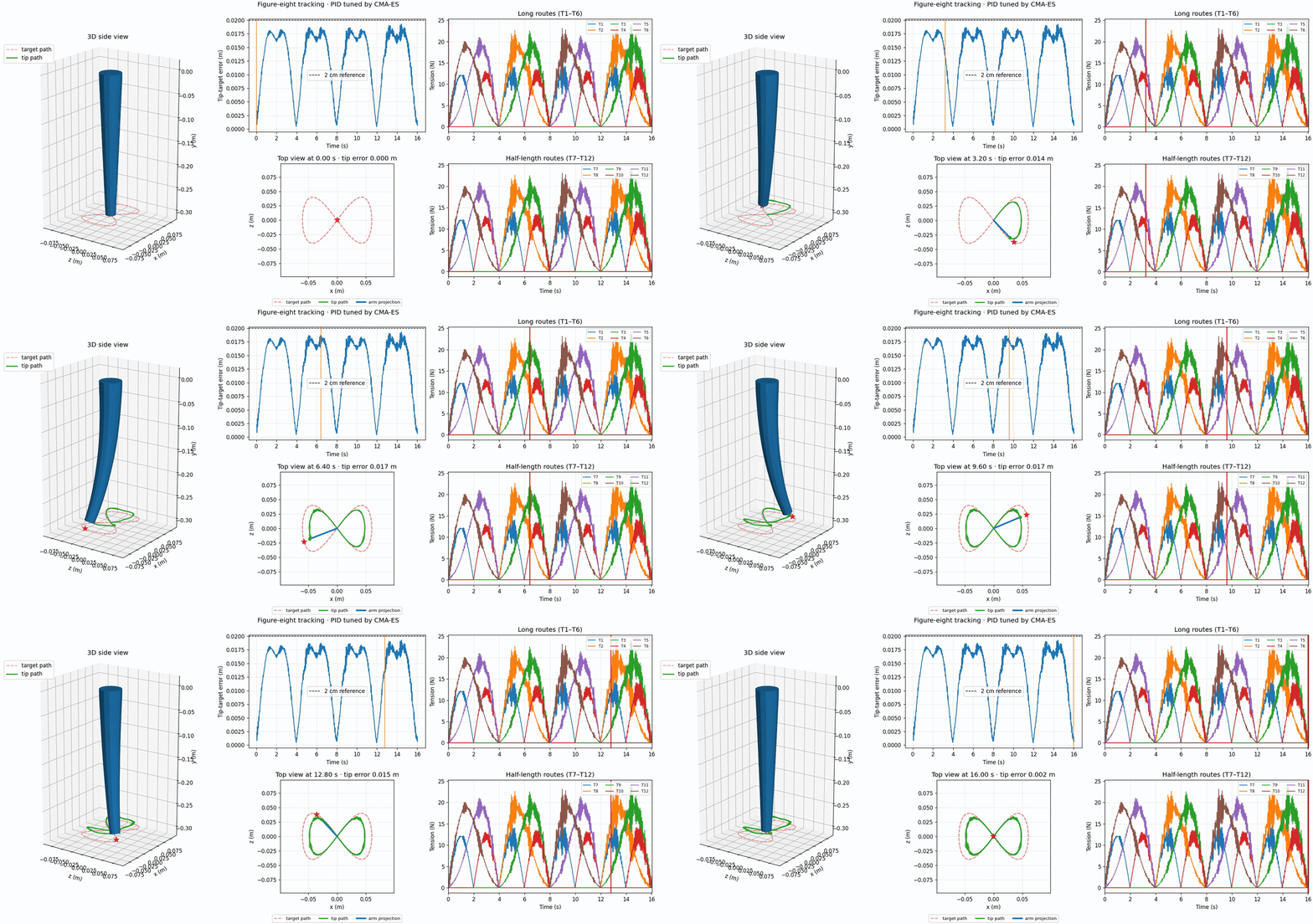
See the tendon-arm guide for the environment model.
Getting started
Development